Introduction
- Introduction
- What a “plugin” gives you
- When custom integration is the responsible choice
- Total cost of ownership (the honest version)
- PCI and compliance framing (high level)
- Decision checklist (use in internal meetings)
- Hybrid approach
- Migration and “when to switch” scenarios
- ROI framing (practical, not hype)
- Related reading
- About PatSaTECH
Merchants usually want the fastest path to accepting cards. Engineers want the cleanest long-term architecture. The right answer is rarely “always buy a plugin” or “always build custom.” It depends on processor capabilities, cart complexity, and who maintains the code after launch.
At PatSaTECH, we ship payment gateway plugins for widely used carts and also build custom integrations when catalogs do not cover a processor or workflow. The framework below is how we explain tradeoffs to clients—written so you can apply it with any vendor.
What a “plugin” gives you
A maintained payment gateway plugin typically bundles:
- Admin settings mapped to processor credentials and modes (sandbox vs live).
- Checkout behavior aligned with that processor’s recommended flow (redirect, hosted fields, tokens).
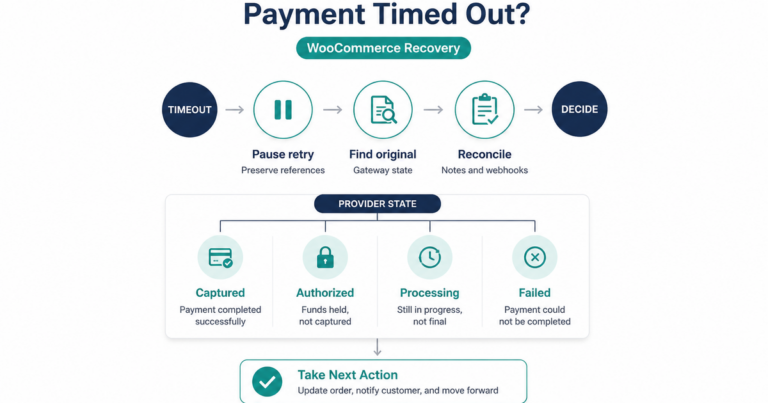
- Order state updates driven by payments and, when documented, webhooks.
- Updates when APIs or WooCommerce breaking changes require them—if the vendor is active.
Experience signal: Plugins pay off when your needs match what thousands of other stores already do: single merchant of record, standard Woo checkout, common currencies.
Browse proven extensions in our shop and by platform—for example WooCommerce gateways, Gravity Forms, or Easy Digital Downloads.
When custom integration is the responsible choice
Consider custom integration (or heavy fork of a baseline) when:
- No maintained plugin exists for your processor + cart combination, or the only options are abandoned.
- Marketplace or multi-vendor payouts require split logic that standard plugins do not model.
- ERP or accounting must be the source of truth for capture timing, tax, or fulfillment locks.
- Headless or decoupled front ends mean WooCommerce is not the only system receiving webhook events.
- Regulatory or bank rules require fields, risk checks, or audit trails not exposed in off-the-shelf UIs.
Custom work is not “more elite”—it is more scoped. You pay for discovery, test harnesses, and documentation so your team is not reverse-engineering payment state at 2 a.m.
Our starting point for bespoke work: custom payment gateway integration.
Total cost of ownership (the honest version)
| Factor | Plugin (maintained) | Custom |
|---|---|---|
| Up-front cost | Lower | Higher |
| Ongoing cost | Updates + support renewals | Retainer or periodic upgrades when APIs change |
| Time to first live transaction | Usually faster | Depends on scope |
| Risk if processor changes API | Vendor updates (if active) | You own the change plan |
Expertise signal: Be wary of quotes that ignore webhook reliability and refund flows. Half-integrated gateways cost more in chargebacks and finance time than a careful build.
PCI and compliance framing (high level)
Whether you use a plugin or custom code, merchant PCI obligations depend on how cardholder data flows—not on whether you paid for a premium plugin. Hosted and tokenized patterns often reduce scope; mishandled custom forms can widen it.
Use your acquirer’s SAQ guidance and the PCI SSC materials. Plugins should describe checkout type clearly; if they do not, revisit how to evaluate payment gateway plugins.
Decision checklist (use in internal meetings)
- Is there a maintained plugin for our exact processor line and capture model?
- Do we need only standard Woo order states, or custom objects and ledgers?
- Who owns webhook monitoring and replay procedures?
- What is our rollback plan if a gateway release breaks checkout on Black Friday weekend?
If answers skew “standard” → plugin first. If “custom objects / multi-rail” → plan custom or hybrid.
Hybrid approach
Sometimes the right answer is plugin for core checkout plus a thin custom module for reporting, webhook forwarding to ERP, or admin dashboards. Document interfaces between the two so upgrades do not break the glue code.
Migration and “when to switch” scenarios
Teams often stay on a plugin too long because checkout “basically works.” Consider a deliberate re-integration when:
- Your processor deprecates the API version your extension relies on and upgrade paths are unclear.
- Webhook reliability is a recurring incident (webhook monitoring).
- Finance cannot reconcile refunds and captures because order state and gateway state diverge weekly.
Switching costs should include sandbox time, stakeholder training, and a rollback plan—not only the development quote. For operational mistakes that masquerade as gateway bugs, see common WooCommerce gateway mistakes.
ROI framing (practical, not hype)
Plugin TCO is usually license + renewals + staff time when APIs change. Custom TCO is build + retainer but can be cheaper than permanent workarounds for multi-entity or marketplace models.
Ask internally: “If our gateway integration broke on the busiest weekend, who is on call and what is the runbook?” If the answer is unclear, invest in documentation and monitoring before feature work.
Related reading
- WooCommerce payment gateway integration checklist
- How to evaluate payment gateway plugins
- Buying a payment gateway plugin for WordPress
- Payment gateway glossary
- Get a quote for scoped custom work
About PatSaTECH
We have delivered payment gateway plugins and integrations since 2011, with extensions for WooCommerce, Gravity Forms, EDD, Magento, PrestaShop, AbanteCart, and more. We bias toward documented sandboxes, clear support boundaries, and checkout behavior you can explain to finance.